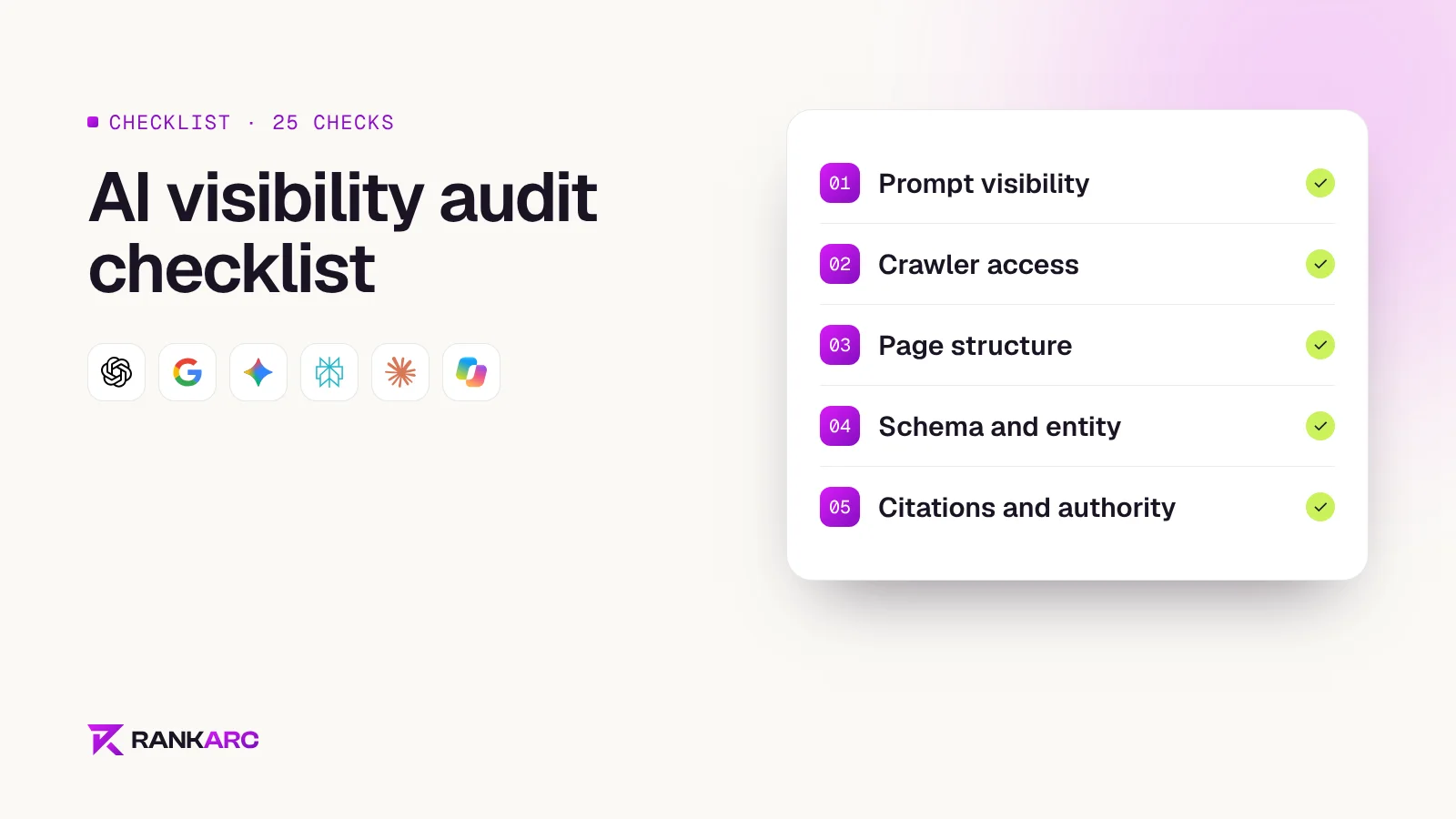
An AI visibility audit answers one question: when your buyers ask an AI assistant about your category, does it name you, and if not, why not?
This is the checklist we run for every RankArc audit. It has 25 checks in five parts. You can do most of it yourself in an afternoon with a browser and a spreadsheet.
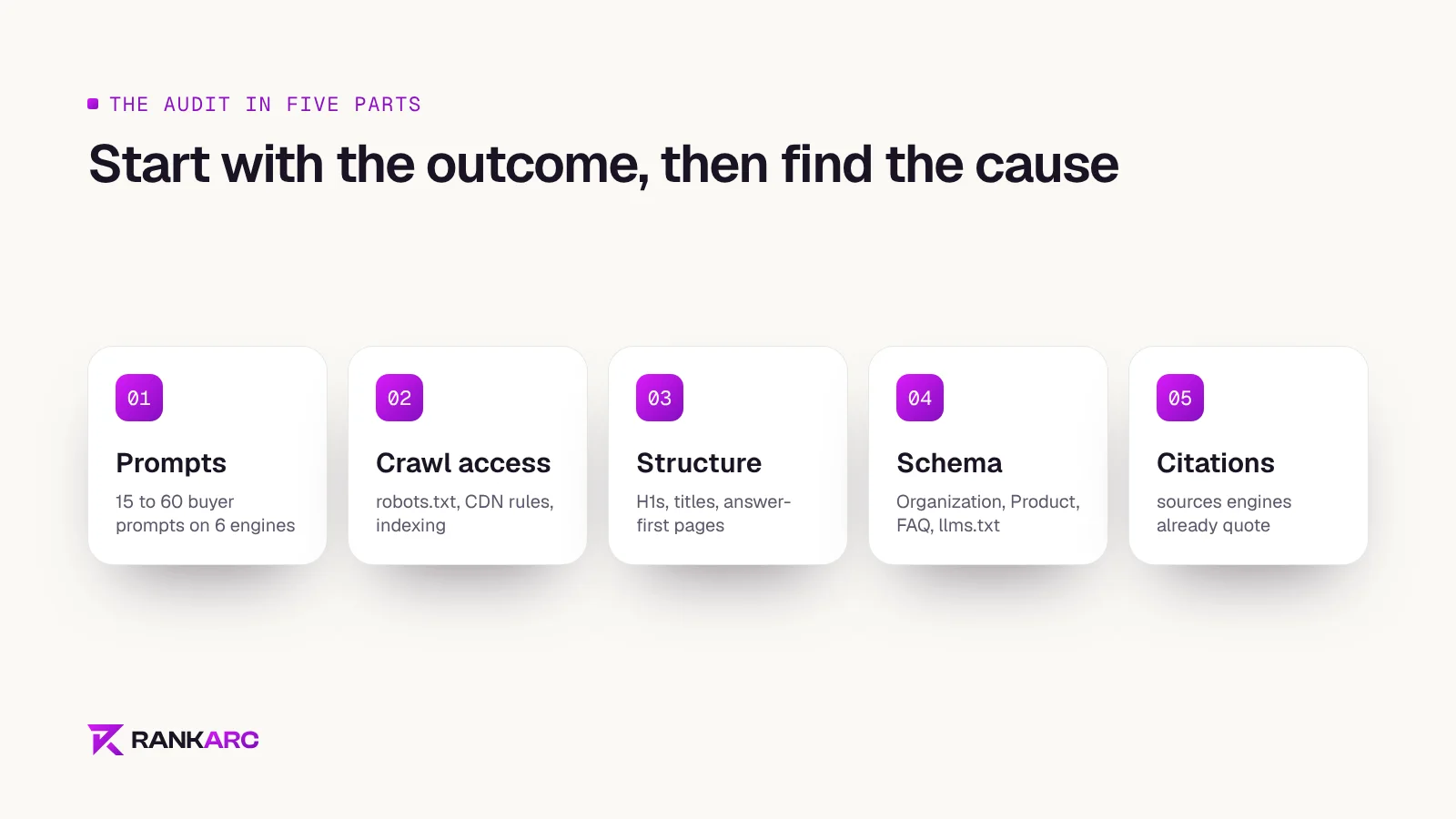
Part 1: Prompt visibility
Start with the outcome, then work back to the causes.
- Write 15 to 60 buyer prompts. Use the words buyers use, including budget and location: "best hand tufted rugs for a living room in India under ₹10,000". Mix commercial ("which brand"), transactional ("where to buy") and informational ("how to choose") questions.
- Run each prompt on six engines: ChatGPT, Google AI Overviews, Gemini, Perplexity, Claude and Microsoft Copilot.
- Record every brand named, its position in the answer and the sources cited.
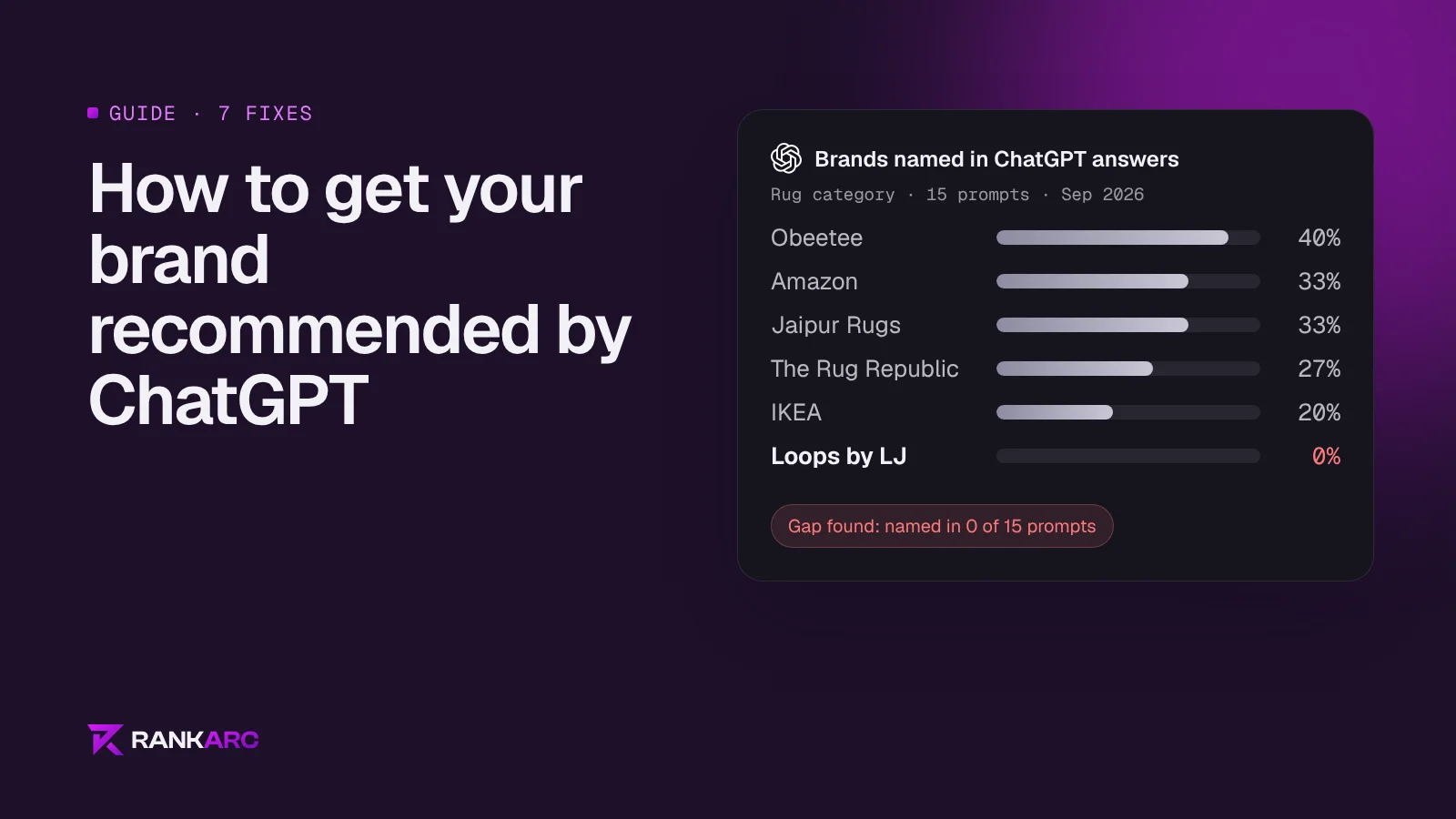
- Calculate share of voice: the share of prompts where each brand appears. For a rug brand we audited, the leader appeared in 40% of ChatGPT answers and the client in 0%.
- Note prompts with no brands at all. These are open ground. In the rug category, two prompts about luxury designer carpets returned no brands.
Part 2: Crawler access
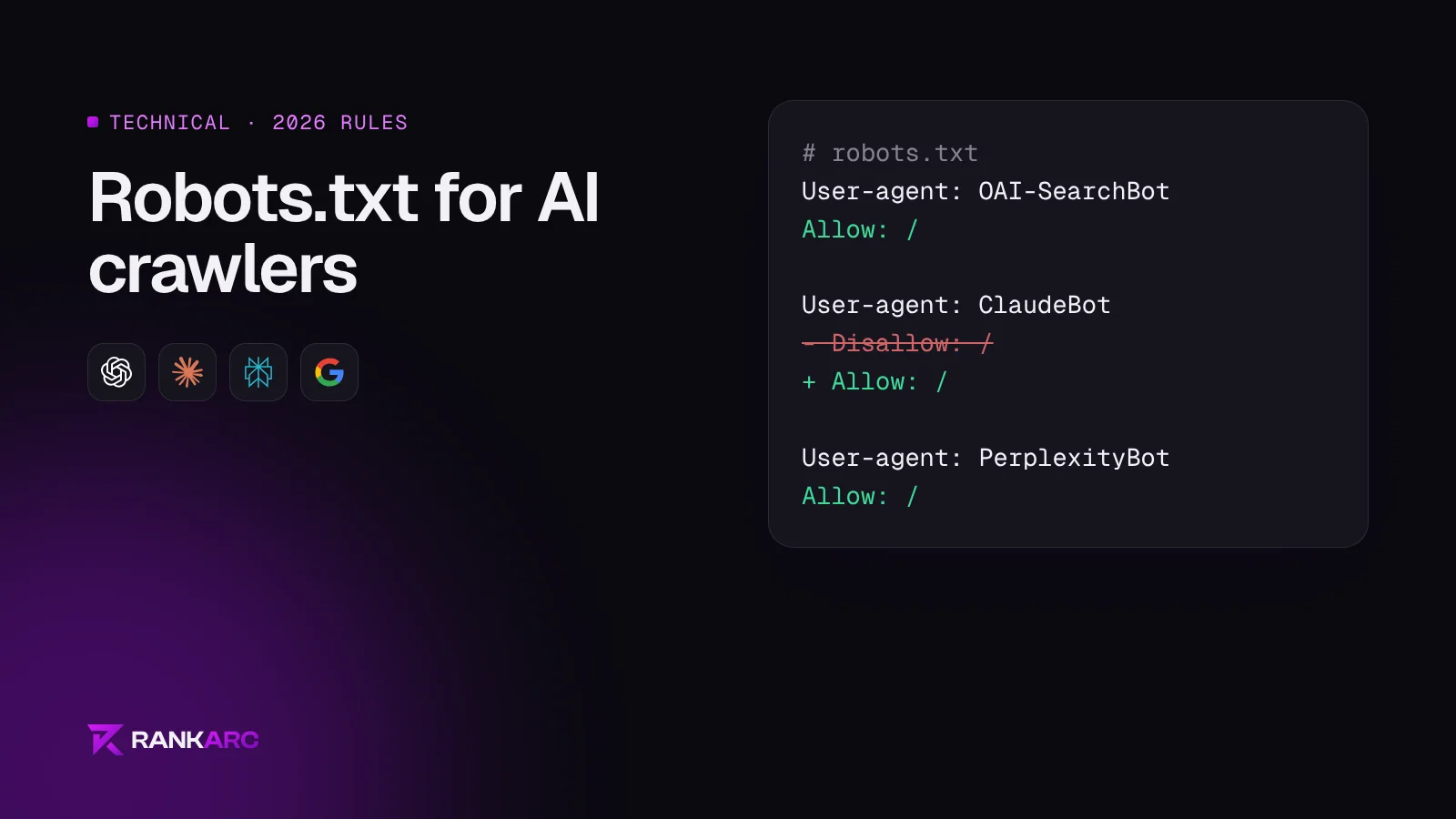
- Read your robots.txt for OAI-SearchBot, GPTBot, ClaudeBot, Claude-SearchBot, PerplexityBot, Google-Extended and Applebot-Extended. Our robots.txt guide explains each one.
- Check your CDN or firewall for AI bot blocking that sits outside robots.txt.
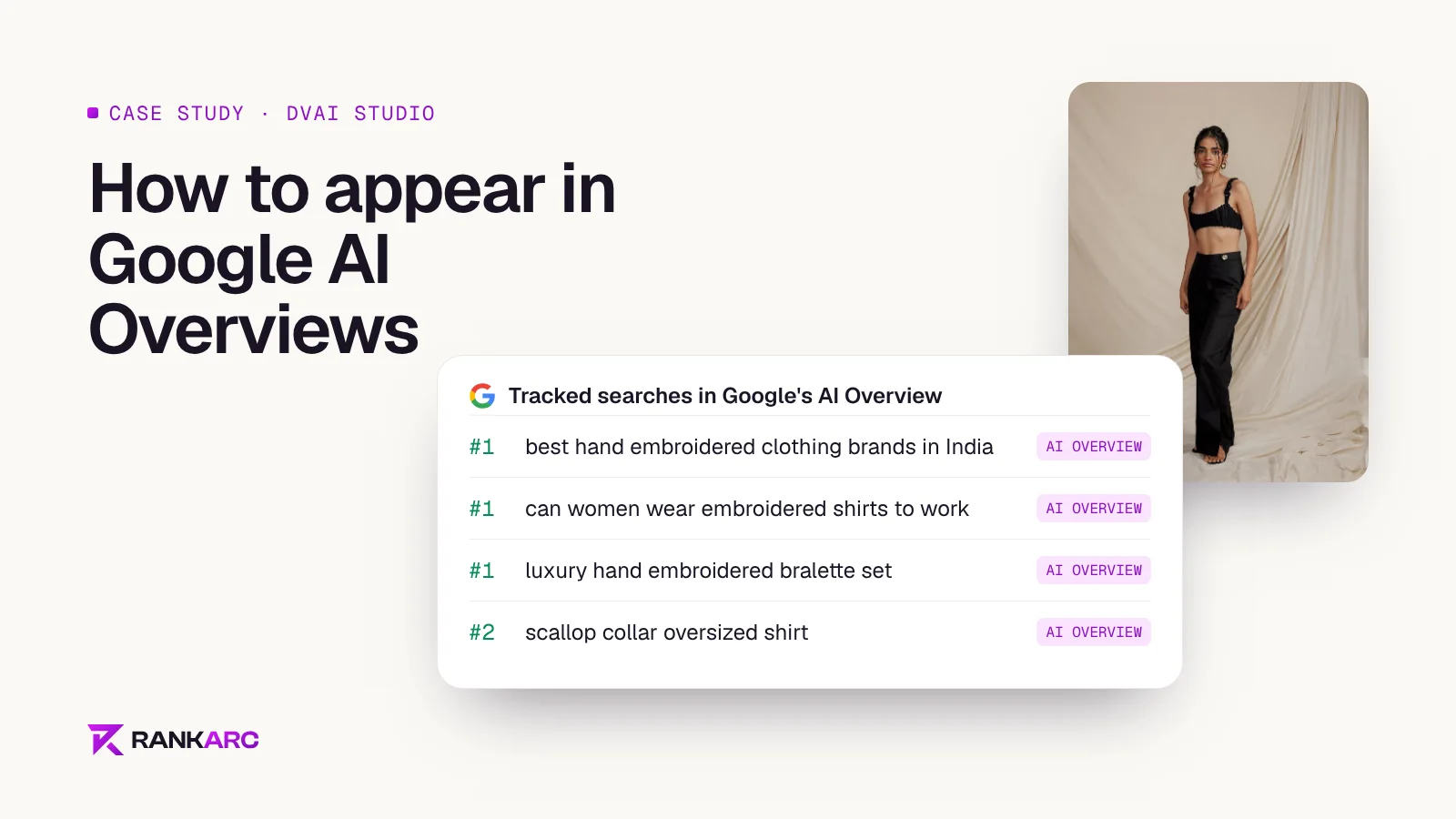
- Confirm key pages are indexed in Google. EatProt had product pages that were not indexed at all, so they could not appear in Google or in AI Overviews.
- Test that pages render without JavaScript. Many AI crawlers do not run scripts, so content loaded only by JavaScript may be invisible to them.
- Check page speed on mobile. One store we audited took 24.6 seconds to show its main content on mobile.
Part 3: Page structure
- One H1 per page that names the thing on it. On one Shopify store, 165 of 530 pages had none.
- Unique titles and meta descriptions. Look for duplicates, titles under 30 characters ("Blog", "News") and titles that get cut off.
- Answer first. Does each key page answer the buyer's question in the first two or three sentences?
- Product names that say what the product is. "Yama Organic Table" tells an engine little. "Yama solid wood round side table" tells it a lot.
- Image file names and alt text that describe the image, not hash strings from your upload.
Part 4: Schema and entity
- Organization schema on the homepage with name, logo, URL and sameAs links.
- Product and Offer schema on product pages, with price and currency.
- FAQPage, Article and BreadcrumbList where they fit.
- Validate everything with Google's Rich Results Test and the Schema.org validator.
- Consistent facts across the web. Your name, address, founding story and customer counts should match on your site, Google Business Profile, marketplaces and social profiles.
- An accurate llms.txt. Check
yourdomain.com/llms.txt. Shopify generates one by default; make sure it lists your best pages. See our llms.txt guide.
Part 5: Citations and authority
- List the sources engines cite for your prompts. These are the sites to be on.
- Check your backlink profile for toxic links. A decor brand we audited had a top anchor text reading "buy backlinks online cheap" from a PBN-style site.
- Find unlinked brand mentions that could become links.
- Compare Google rank with AI mentions. A big gap, such as position 1 on Google and 0% in ChatGPT, usually points to a crawl, schema or entity problem rather than a content one.
How to prioritise what you find
Fix in this order:
- Anything that blocks reading: robots.txt, indexing, rendering.
- Anything that confuses meaning: missing H1s, duplicate titles, inconsistent facts.
- Missing structure: schema and llms.txt.
- Missing answers: pages for the prompts where nobody is named yet.
- Missing authority: citations on the sources engines already trust.
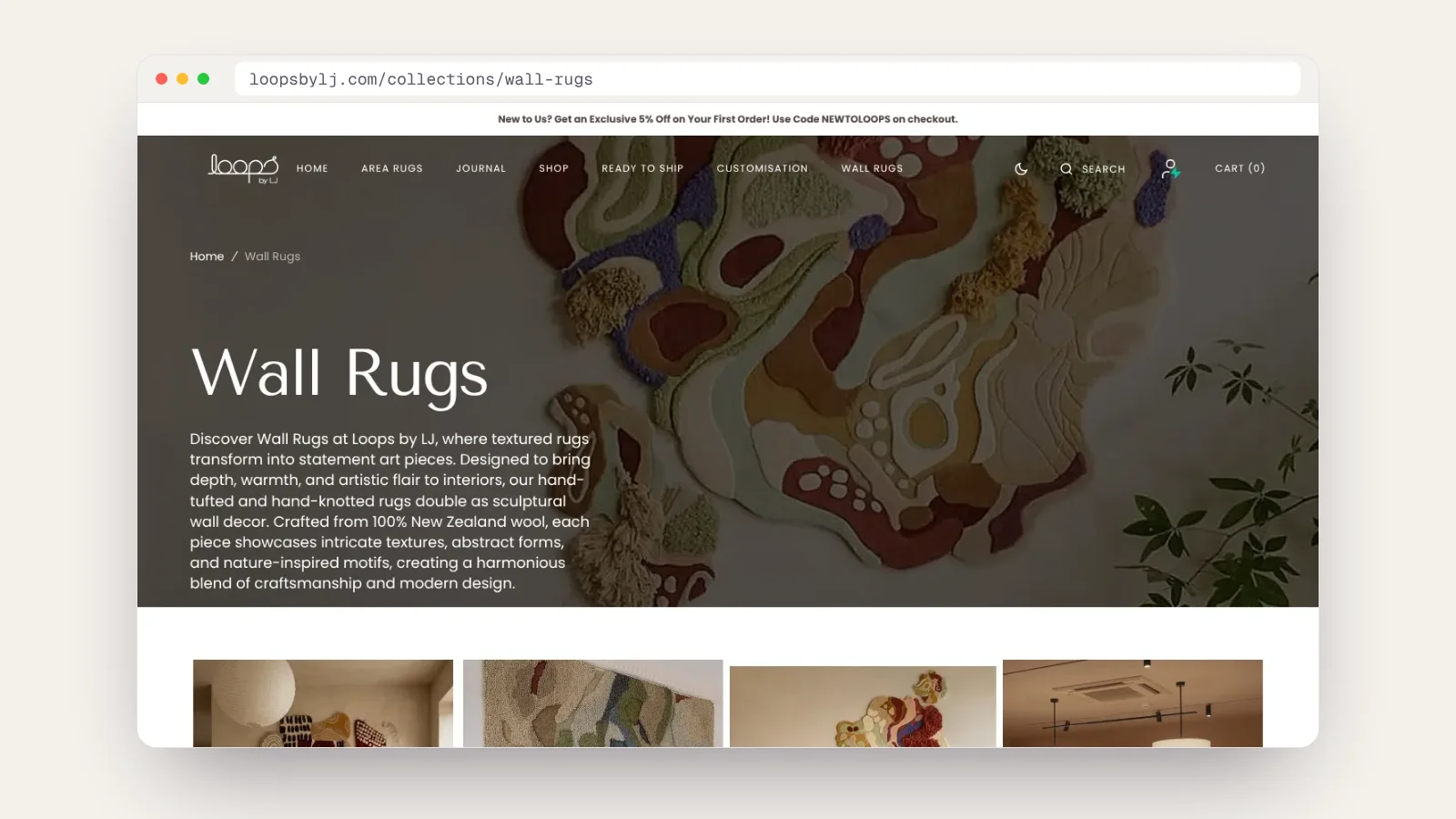
The first two groups are usually a week of work and often move Google rankings too. Loops by LJ went from about 211 to 640 estimated monthly organic visits in 8 weeks after the template and on-page fixes.
Questions
How often should I run an AI visibility audit?
Run the full audit once, then track your prompt set monthly. AI answers change as models and indexes update, so a single snapshot goes stale quickly.
Which tools do I need?
A browser, a spreadsheet and logged-out or temporary chats for each engine. Tools such as Ubersuggest and Ahrefs now include AI visibility tracking that automates the prompt runs.
Can RankArc run this audit for me?
Yes. Our free AI visibility audit covers all five parts and sends you a written report with the five fixes we would make first, within 2 business days.